Friday, April 3, 2009

Orphan Day 2009


The Middle East designated the first Friday in April as "Orphan Day" when special attention is paid to children who have lost one or both parents. We set out early to brighten the day for a few of Iraq's orphans here in Amman.

First we went to the toy shop at our local mall and had a small shopping spree - snazzy remote-control cars for the boys, dolls for most of the girls, beading kit for an older girl, and toddler toys for the youngest. The friendly shop keeper wrapped them all in bright metallic paper while Maha put the names on the tags...


...We called our favorite taxi driver, Khalid, and set off to deliver the gifts to four families whose children had all lost their fathers.

We had not met these families yet but they had been recommended by social work volunteers from another NGO as being "needy" so we were a little surprised when we entered the building where the first family lives - it was quite beautiful - certainly much nicer than the types of dwellings most Iraqi families live in.


We brought gifts for three brothers: Taher - 13, Ali - 9, and Hussein - 5. Their mother, Eman, met us at the door and invited us in graciously. I was immediately struck by how humbly dignified she was - and how deeply sad she looked.

Eman and her husband were from different sects - as was very common before the US invasion and it was basically "not an issue". But afterwards, as neighborhoods and districts began dividing by sect, their neighborhood became Shia-dominated and her husband began receiving threats after one of their neighbors told the militia he was Sunna.

They first came to Jordan in 2006 and only stayed for 6 months before going to Syria to get medical treatment for Hussein who has a blood disease. They were in Syria only one month when her husband returned to Baghdad to try to sell the shop he owned there. He never returned. Militia shot him multiple times in the head.

The family returned to Baghdad because the hospital would not turn over his body unless she herself came to get it. The militia had taken over her husband's shop and their home. They lost everything. Tahir, only 10 years old at the time, became the target of threats. He received a note wrapped around a bullet - the message was clear. His life was in danger.

Eman moved her family from area to area of Iraq for awhile, back to Syria, again to Baghdad and then to Jordan a year ago when they were finally granted visas . The eldest boy, Tahir said that it's been very difficult for him to get his education while living on-the-run but he told us that he studies extra hard and his grades are good.

Eman told us that they receive no assistance from UNHCR or NGOs; Collateral Repair Project is the only organization that has offered them anything. Tears well up in her eyes as she tells us they rely on charity to survive. The nice apartment belongs to one of her husband's business colleagues and he lets them stay there rent free. Family in Iraq helps sometimes by sending money. One of her husband's brothers pays for the kids school fees. They had been a wealthy family before the invasion. Eman has a difficult time accepting charity from even her family but must to survive.

I ask Tahir what he remembers about Iraq. With amazing calm he told me:
"I was in school, in my classroom and we heard the sound of planes. There was huge sound and they dropped a missle on our school. All I saw was blood and more blood and all of us were crying. The missle killed all of the kids in the classroom where it directly hit. All I got was shrapnel in my legs" He says he has 'bad' dreams sometimes.

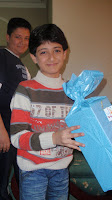
Hussein wants to return to Iraq and always asks his mom, "When can we go back to our house in Baghdad?"

Eman tells us she found the boys playing in their bedroom the other day, one with his head wrapped like a militia member, another with a toy gun, and the other with his eyes blindfolded and his hands tied together.

She tells us that they received an offer to resettle to the US but she refused it. She said she cannot go there - knowing no-one - especially since her health is bad. She has a blood clot in her brain and the doctor told her that if there is a second one, she will likely die. She cannot work and needs medical care. Eman knows she will not get support she needs in the US.

Although these kids escaped the violence of Iraq, their loss and the horrors of war will follow them wherever they go.


Wednesday, April 1, 2009

risks - and responsibilities

When I began this blog, I intended to create a post each night about the families we visited and brought assistance to that day so that you could experience, as I do, these families' stories and perhaps get an idea of the immensity of their struggles and suffering

I want to do this because I see how much more is needed and I know that you would be overwhelmingly compelled to do anything you could to alleviate their suffering if you could be here as I am, sitting in their simple homes, hearing over and over again, day after day their sorrows and fears. I wish I could share with you the palatable helplessness and hopelessness in nearly every home I visit. I wish I knew how to bring their tears to this page and their amazing and unfathomable forgiveness for those of us whose nation cause these tears. I get upset with myself because I just don't have the skill to make their pain real to you and I am frustrated that the long hours of our days and emotional exhaustion leave me little time or energy to write.


At times I am overwhelmed by knowing where to start and just which of the many, many ways Iraqis suffer and struggle here should take priority when I do have time to write. In every aspect of their lives and for Iraqis of every age, the challenges are myriad; their losses immeasurable. I start out stunned and outraged at one problem in the first home we visit in the morning and then, by the end of the day when I sit down to choose which family's challenges to share with you, of all their many and equally compelling challenges, I cannot decide which is the most critical.


Every aspect of Iraqi refugees' lives is a crisis and an emergency. Now I often sit on all of these stories for a few days, waiting to see which one nags most at me, demanding me to tell it.


One of these is the insecurity of living here without legal residency. I think of a family we recently took food assistance to. When we arrived, only the mother and youngest children were at home. She was anxious and explained that her husband and eldest son were at the police station, trying to convince them to give their passports back. They had fallen only one month behind on their rent and the landlord was angry and he called the police. The police came and took her husband and son to prison for two days. The landlord put them and their things out in the street. A friend found a new apartment for them and loaned the family money to pay the back- rent they owed at the first apartment. Even though the debt had been satisfied, the police took and would not return the family's passports unless they would get a Jordanian "sponsor".


Like most Iraqis here, this family does not have Jordanian friends who can provide sponsorship. This results in unscrupulous people offering their sponsorship for a "fee" that is usually beyond the Iraqis' ability to repay. Too often we meet Iraqis here who suffer threats and intimidation when they fall behind on paying off their "sponsors".


The woman we were visiting told us she was nervous, waiting for her son and husband to return from the police station. She knows her husband, because he is a man, is especially vulnerable to imprisonment or being forced to return to Iraq. "But", she told us, "if my son went alone, we do not know what they might do to him."


I consider going to the police station to intervene, in hope that perhaps a westerner's presence and interest might facilitate the return of the passports. I decide not to this after considering the high risk that my "interference" would only provide the authorities provocation to further harass this family after I leave Jordan .


Iraqis without residency are extremely vulnerable. They cannot count on justice in the same way citizens can. They cannot ever feel confident in their safety - only because they are Iraqi.


It is not uncommon that citizens and some police "toy with" Iraqis here, letting them know they are not welcome and that they are powerless. Police do random stops of Iraqis - especially men - in the streets. People are pulled in for questioning (which provokes terror of forced repatriation to Iraq) for no discernible reason. If there is a simple problem between neighbors - or even between children, if the police are called, Iraqis take all of the blame and suffer unreasonable consequences. Iraqi victims cannot report crimes against them because it is likely they will be persecuted while their perpetrators remain free. Even some Iraqi children suffer harassment and, in some cases, violence against them at school. If they report it to their teachers, they are punished. I hear them too often to discount the stories about some Jordanians who work in some large aid organizations and who belittle Iraqis or deny them assistance arbitrarily for no apparent reason. Risk - of being forced back to Iraq, of imprisonment, of assault, of emotional abuse - is a fact of life for most Iraqi refugees here, causing many to stay cooped up inside their homes.


This came up recently when Maha and I were discussing possible ways CRP could give Iraqi mothers a special day on Mothers Day. At first we considered renting a couple of buses to take the mothers and their families out of Amman to a beautiful location for a picnic and day of fun - something they rarely experience in their harsh lives. We knew this would provide a memorable occasion for them and temporary distraction from their troubles. But then we had to consider the risks of being stopped at checkpoints and what might happen when the guards found a bus full of undocumented Iraqis. We next considered a picnic at a local park so that families could find their own transportation. But even this was too risky; gatherings of Iraqis would cause unwanted attention. We then came up with the much more modest plan to deliver cakes, flowers and good wishes to them in their homes to avoid causing problems for them.


Last night, I walked home along the busy street on one side of the huge Sports City complex and park that has a football (soccer here) stadium. There were scores of police lining the street, armed with long clubs. I asked why and was told that a game was about to end and that jubilant fans might become unruly. I was also told that often, if Iraqi or Palestinian teams have won, the police randomly beat celebrants on their way out of the stadium. Since both are resented here, racism lays just beneath the surface and events like this give opportunity for that racism to go over the line into violence. My friend told me that they had even seen an elderly woman beaten on her head as she exited the stadium. With a sigh he continued, "Iraqis and Palestinians are not even allowed to celebrate their joys openly"


I struggle as I try to understand this.


The massive influx of Iraqis to Jordan put a huge strain on limited resources here. Rents skyrocketed as desperate Iraqis poured in, needing someplace to live. Poor Jordanians and Palestinians suddenly had to vie with Iraqis for the limited number of low-price rentals. Some landlords took advantage that Iraqis were willing to pay more than the usual rate just to have a roof over their heads and they would rent to Iraqis at prices residents were unable to afford. Low-wage labor positions at below standard wages were gratefully taken by Iraqis unable to legally work here and desperate to have any employment. Jordanian and Palestinian residents had to accept lower wages and worse working conditions than before along with more competition for these jobs. When residents began to suffer so greatly because of the Iraqis flooding into the country, is to be expected that this would result in resentment directed at those perceived to have caused the problem.


But I was startled when I found out that additional resentment directed at Iraqi refugees is explained and justified because many here blame Iraqis for 'allowing' the US to take out Saddam. He was respected by many here because he sympathized with Palestinians suffering under US-supported Israeli occupation of Palestine. Also, under Saddam, citizens of Arab countries could attend colleges and universities in Iraq without tuition - in fact, many were given stipends in addition to free tuition. Saddam also had the guts to stand up against US efforts to dictate oil prices and Iraq's oil wealth was used to provide its citizens with high standards of living. He was considered to be a champion of Arabs.


Although Jordan itself is considered to be a "friend" of the US, many residents here resent the US meddling in Arab affairs, theft of Arab resources, and the US support of Israel. By some inaccurate logic, many here perceive Iraqis' inability to stop the US invasion and destruction of the Saddam government as either a failure by Iraqis to protect their country or even that they cooperated in its destruction. It is hard for me to understand this rationale - how were Iraqis, citizens of a small nation who had been weakened by 12 torturous years of sanctions, supposed to stave off the world's superpower and its multi-trillion dollar military apparatus?


But, even considering the ways Iraqis are made to feel unwelcome here, I cannot fault Jordan for having the headache of having to deal with nearly a million refugees pouring over its borders from Iraq through no fault of its own. Along with Iraqis, Jordan and its residents are paying the price for US greed. Jordan cannot be expected to pick up the pieces and support those who had to flee from war. With limited natural resources - especially water, - unemployment rates that were already high before the invasion, and sensitive internal political and social concerns, this tiny nation should not have had to take on the additional burdens that resulted by the invasion of Iraq. Despite the imperfection in some of the ways it has dealt with this problem, Jordan is to be commended on its generosity in accepting so many Iraqis to seek safe haven here. The US, the cause of this exodus, by comparison has only admitted a small number of Iraqis inside of its borders.


It was entirely predictable that assimilating a rapid and immense influx of Iraqis would stress this country and its citizens. And it is also to be expected here, as it would in any country, that this would result in resentments and abuse of those who seemingly caused this distress. But Iraqis have been dealt a double whammy - unable to live in their own country, they cannot live freely here. They face death at home and humiliation and intimidation living in extreme poverty here.


Most of us have been taught since we were children that, when we break something, it is our responsibility to fix it or pay for it. The suffering of Iraqis and the great strain on Jordan and its citizens needs fixing - badly. The US, through its criminal folly in Iraq, is responsible to compensate Iraq, Iraqis, and Iraq's neighboring countries for generosity forcibly demanded of them by this situation. Until every Iraqi can return to a safe, functioning and independent Iraq, they - and those who shelter them - must be compensated


~*~


I go out each day here and witness the damage that's been done to Iraqis "in our name". I try to understand it so that we can find ways to repair some of it and the immensity of it is beyond what I can comprehend - even after being immersed in this issue and with the Iraqi refugee community for the past few years.


I sometimes feel discouraged when I see the damages as being too large for us to effectively relieve: we feed a few hundred families out of the tens of thousands of needy; we bring heat to a few frigid homes; another hundred-plus now earn incomes in the safety of their homes because of micro-projects. I see that what we do accomplish is vitally important for those we are able to help but not "enough" by any means because there are so many we cannot help and whose problems are bigger than our capability to address them.


But then there are times when I know that what we provide is sometimes not tangible but as important. I think about going as a guest to listen to a small group of Iraqi women tell a US doctoral student about what their lives are like here. I sat quietly at the table between the interpreter and a woman with a broad, sad face.


The women were asked if they felt integrated and welcome into society here. Their responses were spoken through tears by many of the women. The woman next to me broke down and put her head in her arms on the table, sobbing. I reached over and rubbed her back and handed her tissues. When she looked up into my own eyes wet with tears, I gestured my sorrow and sincere apology. She grabbed onto my hand and held it for the remainder of the discussion group. Afterward she said what so many other Iraqis have: "I know the people - the American people are good people and that they care. Thank you. Thank you"


I especially wish that I could share these experiences with you. At these times, I think that it evident that we are the recipients, we are the ones given what we need for our repair, to sooth our sorrow and guilt, to assure us we are still human.


I am amazed by Iraqis and have such tremendous respect for their capacity to forgive - to love - when they have every reason not to and when it must be so hard for them. We have much to learn from them about generosity!


But first we must risk opening our eyes to see what we have done and what we continue to allow to be done in our names. We must risk accepting that if we did, we would understand that our response to repair must be equal to this damage or we are not doing "enough"

Honoring the strength, selflessness and courage of Iraqi mothers


March 21rst is Mothers Day in the Middle East. Maha and I delivered special cakes and potted flowers to Iraqi refugee mothers on their special day.

Many of the mothers we honored have lost children and husbands because of the US-led invasion. All are trying to care for their children under the most daunting circumstances. They struggle every day to provide adequate food and shelter for their kids. They fight to provide their children with education. They comfort children who have been traumatized by war. Many of their husbands are despondent without the ability to work to support their families and these wives endure much and they do their best to support and respect their partners during these difficult times. They nurture their families despite being traumatized themselves and the incredible challenges each day presents to them.


To make their day special, we honored them with cakes that they could never consider being able to afford and that they could share, as they share themselves so unselfishly, with their families. We brought them growing flowers as symbols of the beauty of their effort to nurture the lives that came through them. When we could, we gave the children the gifts to take into their homes to present to their mothers, resulting in many delighted smiles and kisses!


And with each delivery, we told these remarkable women that "Amrikan" and others of many nations give these gifts -

"with our love and respect for the courage, selflessness and strength
of Iraqi mothers and that we have not forgotten them"


photos of some of the mothers you honored on Mothers Day

Wednesday, March 25, 2009

Wounded Children


We first met Fakir and his family in late summer 2008 when we provided Fakir with a micro-project of tools he needed to make his intricate and graceful art plaques.

One day, when doing a follow-up visit, his two daughters showed us a letter they had written to UNHCR that brought tears to our eyes and compelled us to take a special interest in helping this family overcome some of their many obstacles. His daughters' letter began, "All over the world, children love their childhoods; they are supposed to love them" and continued, "but we hate ours." The two girls then wrote of the many challenges they faced and made a plea for help.

All four children were traumatized during the initial invasion in 2003 and suffer involuntary incontinence as a result. Their parents had taken them to a doctor in Amman and was told that they were "misbehaving"! With the frustration of dealing with a home that smelled of urine, inadequate laundry (and even water to do laundry with), as well as his own depression, Fakir had been punishing the kids after hearing this "diagnosis". Our first step was to let him know that this was not intentional behavior and then to find solutions. Some CRP supporters sent funds for thin, easier to launder blankets, waterproof bed pads, and sheets. Some in the medical community offered advice which we passed along. We encouraged the parents to show loving understanding with their children in order to lessen the stress that only increased their incontinence.


We brought special gifts for these kids who have endured so much - new tops and a toy each

At that time, all of the children had left school. Other students teased and bullied them and the older boy was afraid to even go onto the streets because bullies had assaulted him. Even their teachers had ridiculed them about their incontinence - one of their teachers actually held her nose in disgust when the child walked by and the other students in her class followed her example.

Fakir's kids were vulnerable to this sort of abuse for other reasons, too. Iraqi children are taunted and bullied just because they are Iraqi. Jordan is primarily Sunna and Fakir's family is Shia. Being from the southern part of Iraq, they are also very dark skinned. This type of abuse occurs most often in some of the poorer areas of Amman. Finally, in frustration and with the intention of protecting his children, Fakir had pulled the kids out of school.

We knew that an education was important if these kids were to be able to overcome the many obstacles they face. They wanted to attend school. We worked with them on strategies to counter bullying and helped with new shoes, book bags and school supplies. They enrolled in diferent schools than they attended before and have remained in school.

On our recent visit, they told us that the daytime incontinence has improved greatly - the kids are no longer wetting themselves although they must still leave the classroom to use the restroom frequently. Their teachers know that they must be allowed to use the restroom more frequently than the other students. But recently both of the older children had been refused when they asked to be excused. One child obeyed and wet herself. The other left the classroom to avoid wetting himself and was punished for disobeying. One of the children is so upset that she wants to leave school again.

I will make appointments to visit both schools, letting the staff know that I am an interested friend of the children who is invested in their education and ask that we discuss together how we can all best facilitate the children's success in school. I hope that this has some effect. These are bright kids with a tough road ahead of them if they do not continue their educations.

The damage of war extends far beyond the battlefields. Many of its youngest victims carry their wounds inside them. These wounds do not heal as readily as those to the body. We must do everything we can to heal these deep wounds but it is challenging when these children are wounded again and again after leaving the war zone.

no recourse but to run - March 25 09

As we rode in the taxi to make food assistance deliveries today, Maha told me that one of the families we know has a grave problem.

The only daughter, a young woman, recently took a job in a clothing shop. She only worked a few days when the owner's brother (and buyer for the shop) asked the girl to make coffee for him. When she went into the back room to put the coffee on, he followed her inside and then shoved her against the wall, pulling her blouse open so hard that the buttons popped off. As she cried and tried to cover herself, he pulled out his cell phone and video-taped her.

Of course, she left the job immediately.

When her parents complained, the owner did not care that her brother had abused and traumatized this young woman. The shop had paid her wages for the month of 150JD in advance. Instead, the owner insisted that she return the wages. The family had already spent the money to pay bills.

Now this man has threatened to release the video on the internet and to his friends if the family does not pay him 100JD. He says that this incident has caused problems for him with his wife and he wants the money to compensate him for this!

Maha offers to give the family the money to return the wages from the Iraqi donor funds. She tells the mother that it is not wise to pay the money the man is demanding because it is unlikely that this would keep him from demanding more although he "swears on his honor on the Quran" that he will destroy the video once he is paid. I know Maha is right.

This situation highlights the vulnerability of Iraqis in Jordan. As illegal "temporary guests" of Jordan, if victim of crime or abuse, they cannot go to the authorities. The perpetrators are never apprehended and involving authorities usually means that the Iraqi will be hassled, threatened, imprisoned or made to return to Iraq. In this particular case, since the girl was working illegally, she would probably be arrested for her employment while her abuser remains free.

Maha suggests that the family contact UNHCR about expediting their case for resettlement to get away from this situation and risk of further abuse and blackmail. I will include this family on the list I will take to UNHCR to see if they are taking it seriously and are moving to get this family out of Jordan quickly.

An education sacrificed - Food Assistance March 12 09

Wafa'a met our taxi on the busy street near the old Amman downtown and led us down a narrow alleyway to her doorway. Inside, her fourteen year old daughter, Noor, waited with the entryway locked and struggled inside to open the stiff latch when Wafa'a banged on the door. Wafa'a explained that the neighborhood is mostly men and she is concerned about her daughter's safety.

We entered a shabby small courtyard that had a small kitchen area inside one door and another door leading to their combination living and sleeping space. They do not receive a cash grant from UNHCR and Wafa'a cleans houses to pay the 40JD a month rent and for their food. She tells us that "sometimes" her daughter helps her to clean the houses.

Wafa'a will have surgery on her knee in a week but will not be able to work for the month following the operation and does not know what they will do. They are six months behind in their rent now.

Her daughter sat on a sleeping mat near us with a small pile of school books. We asked if she was attending school and her Wafa'a tells us that she recently dropped out. "I can't send her to school. She needs 1JD every day for transportation and money for books. I am tired and my health is bad so she had to stop going."

We tried to suggest some solutions that might allow Noor to return to school and her mother hushed us, telling us that it will only make Noor unhappy to think about returning to school when she cannot. I can't help but think that Wafa'a needs Noor to work and is reluctant to have her return to school. She tells us Noor studies on her own. I am saddened that this young girl will not get the education she needs and wants obviously wants very badly.


Their meager belongings were in piles lined up along the walls. There was an old tv set but Wafa'a told us that it did not work. I wondered what they did in the evenings in this one room. She told us, "I am so tired when I come home after cleaning houses that I only want to sleep"

Food assistance for Kasem and his family - March 12 09


Kasem and his wife, Zaineb have two sons - Mohammed - 12 and 6 year old Thualfekir.

Kasem is an artist - a graduate of a cultural university - and their flat is filled with his paintings. He's set up his easel outside the door to their flat on an interior balcony.


They fled Baghdad in 2006 after Kasem was severely injured from a suicide bomb and militia attack. He and four other artist friends were walking down the street in Karada on, as Kasem told us, "the most famous day when there were five car bombs". Kasem and one of his friends escaped with only bullet wounds. (one of those bullets is still lodged in his leg). The three others were killed in the attack. The family left Iraq a month later when Kasem had healed enough to travel.


They have been told that they will resettle soon to the US. They hope it is very soon as they sold all of their furniture and belongings to have the money to move to their current apartment and to pay two months' rent. The rent is a modest 150JD per month but they cannot pay this with the 100JD they receive as their monthly grant from UNHCR. If they are not resettled by the time these two months have passed, they are not sure what they will do.

I asked Kasem how things in Iraq were different between before the invasion and its current state.

"Things were bad for all the years. They were bad under Saddam
but they are much worse now"

Monday, March 23, 2009

Thanks to you 50 more families will eat for a month - March 14 09

Maha and I went shopping, comparing prices for the best deals and making sure each family would get as much nutritious food as possible in their assistance boxes. The market kindly (and at no charge!) packages each box for us and delivers them to Maha's flat where the pile threatens to overtake her kitchen!


Now we are ready to make home deliveries to the most needy. You'll be reading these families' tragic stories in upcoming blog posts.
Please consider contributing to insure more Iraqi refugee families have enough to eat

Um Abdullah receives her Micro-Project because CODE PINK NYC showed their LOVE


On February 12 CODE PINK NYC held a MAKE OUT NOT WAR benefit to raise funds to provide a Micro-Project for Um Abdullah. Not only did this terrific group of dedicated activists and merry-makers have an incredibly LOVEly time but also shared their love with Um Abdullah and her 5 children and raised $850 - enough to buy Um Abdullah the video equipment she wanted to be able to make help support her family.
(see Um Abdullah's story, "We Want Security..." HERE - midway down page)


The funds arrived in Amman and we took Um Abdullah shopping at the super-sized mall here to buy most of her equipment. She and her daughter were both very ill from the diabetes they both (as well as Um Abdullah's young son) suffer from but they still had a great time getting their dream fullfilled. The next day, she met us at Maha's apartment to pick up the video camera we had to order.


Now Um Abdullah and her two eldest daughters have what they need to make money taking portraits and video-taping and photographing weddings and other special occasions.

THANK YOU CODE PINK NYC WHO PROVES LOVE REALLY CAN CHANGE LIVES!

Pulling together, we can show our love for other struggling Iraqi refugees and make big changes in their lives. If you with your peace & justice, faith community or other affinity group would like to raise
funds for a specific family, please
CONTACT US